About client
Museum in EU
A museum in a major European capital, internationally renowned for the richness of its collections and the quality of its exhibitions. It attracts several million visitors from around the world each year, serving both as a leading tourist destination and a heritage site. Its exceptional popularity makes visitor flow management a critical operational concern.
Challenge
Located in the heart of a major European capital, this internationally renowned museum draws several million visitors from around the world every year. Its extraordinary collections and the prestige of its temporary exhibitions have made it one of the most visited cultural sites on the continent a status that comes with a very particular operational burden. The sheer scale of attendance created compounding challenges across the entire visitor journey. Queues at the entrance regularly stretched to uncomfortable lengths. Inside, footfall distributed unevenly across galleries, leading to bottlenecks in high-traffic exhibition rooms while other areas went underused. Temporary exhibitions with limited capacity were especially difficult to manage, as staff had no reliable, real-time way to monitor how many visitors were inside at any given moment.
Beyond visitor comfort, these conditions carried genuine safety implications. In a landmark building welcoming millions of people, maintaining safe occupancy levels is not optional it is a regulatory and ethical obligation. Yet without accurate, continuous data on visitor distribution, the institution was essentially operating on intuition and reactive management rather than informed decisions.
Long waiting times at entrances and high-congestion points throughout the building
Uneven distribution of visitors across galleries with no structured pathways
No reliable mechanism to monitor or enforce capacity limits in temporary exhibitions
Inability to anticipate peak periods and adapt operations accordingly
Safety requirements increasingly difficult to meet without real-time occupancy data
Solution
3D stereoscopic sensors
The core of the solution is a network of 3D stereoscopic sensors deployed at strategic positions throughout the site. Unlike simple infrared beams or pressure mats, these sensors use stereoscopic depth perception to distinguish individual visitors accurately even in dense, fast-moving crowds. They provide a continuous, precise count of visitors entering and exiting each zone, feeding a live picture of occupancy levels across the entire building at any moment.
Computer Vision (CV)
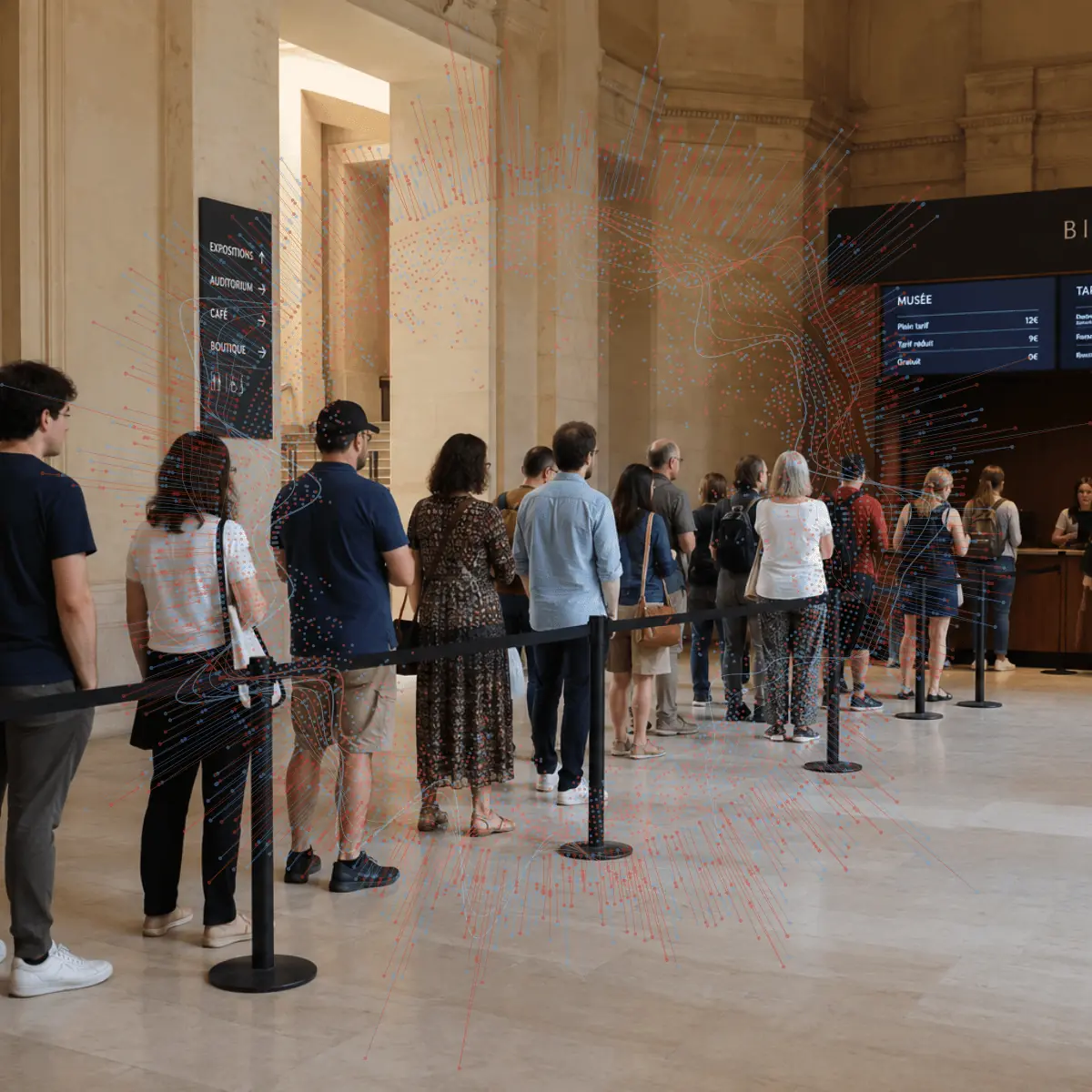
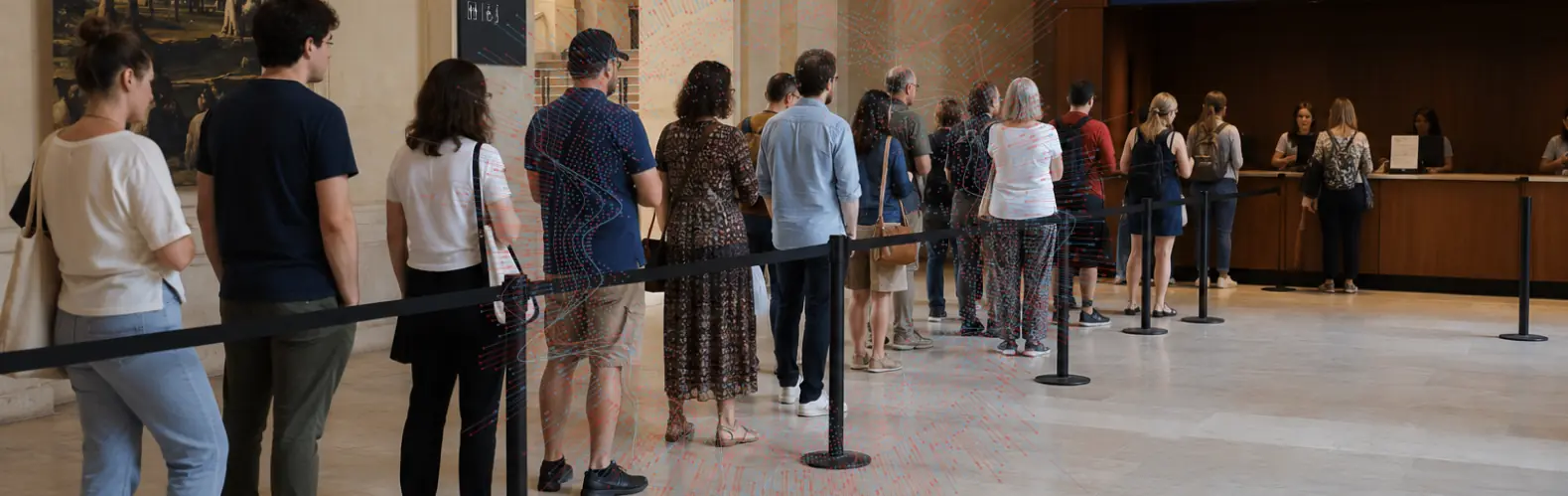
Alongside the counting infrastructure, Computer Vision (CV) technology was introduced specifically to measure waiting times at the museum's entrances. This system uses 2D video cameras equipped with artificial intelligence and machine learning algorithms to analyse queue dynamics in real time calculating not only how many people are waiting but estimating how long each visitor can expect to wait. This data transforms queue management from a reactive task into a proactive one.
VISION Pop
All data streams from the sensors and CV cameras are centralised and processed through Vision Pop, Acorel's purpose-built software platform for monitoring and reporting. VISION Pop aggregates raw counting data into a clear, real-time operational dashboard that museum teams can access and act upon immediately. Entry managers receive live information directly on their tablets, allowing them to make fast, informed decisions about access control, crowd routing, and resource allocation without leaving their posts.
Counting devices installed - 18
Partnership duration - 20+ years
Annual visitors - Millions
Outcomes
Benefits
Optimising visitor numbers
Compliance with capacity limits and enhanced safety
Reduced waiting times
Balancing visitor flows across the day or week, allowing visitors to plan their visit using online access to waiting time data.
Optimisation of visitor routes based on the busiest areas
A data-driven operation that puts visitor experience first
The implementation of Acorel's solution fundamentally changed how the museum understands and manages its spaces. What was once an institution reacting to problems as they emerged became one capable of anticipating and preventing them. The availability of accurate, real-time visitor data across every zone turned people-flow management from a logistical afterthought into a strategic lever. Entry managers gained immediate situational awareness, with live occupancy figures and waiting time estimates accessible on their tablets at all times. This allowed them to open additional access points earlier, communicate wait times proactively to visitors, and redirect foot traffic before bottlenecks formed rather than after. The quality of the visitor experience at the most sensitive moment of the visit, the entrance, improved substantially as a result.
Optimised visitor numbers: Precise control over occupancy levels across all zones, including temporary exhibitions with strict capacity limits.
Enhanced safety compliance: Continuous monitoring of capacity thresholds ensures regulatory requirements are met at all times.
Reduced waiting times: AI-powered queue analysis allows entry managers to act before congestion builds, shortening wait times at the door.
Better operational planning: Historical flow data enables the team to anticipate peak periods and pre-position resources accordingly.
Optimised visitor routes: Real-time distribution data helps guide visitors toward less busy areas, balancing flows across the day.
Smarter visit planning: Online access to live waiting time data allows visitors to choose the best time to arrive, reducing spontaneous peaks.
Inside the museum, the ability to monitor visitor distribution across galleries in real time enabled staff to structure pathways more effectively and balance flows throughout the day. Historical data provided by VISION Pop allowed the operations team to identify recurring peak patterns and adjust staffing, signage, and access management strategies in advance. Temporary exhibitions often the most congested areas due to their limited footprint and high demand could for the first time be managed against firm, continuously monitored capacity limits, ensuring both safety compliance and a better experience for visitors inside. Publicly available waiting time data, accessible online, gave visitors the ability to plan their visits more intelligently choosing to arrive during quieter periods and reducing unplanned congestion. This distributed the benefit of the system beyond the museum's internal operations and into the visitor's own journey before they even arrived.