About client
European airport
The client is a major European airport that handles approximately 10 million passengers annually. The facility manages numerous public sanitary facilities distributed across its terminals to serve this high volume of traffic. To maintain high service quality and hygiene standards while managing fluctuating passenger numbers, the airport shifted from traditional, fixed-rotation cleaning schedules to a modern, data-driven management approach.
Challenge
Improve hygiene management and optimise cleaning operations across high-traffic airport toilet facilities while ensuring efficient staff allocation and service traceability.
The airport faced several operational difficulties when relying on traditional cleaning methods:
Inefficient scheduling: Relying on fixed-rotation cleaning cycles led to unnecessary maintenance during quiet periods.
Capacity issues: High-traffic facilities often became overcrowded during peak hours, requiring urgent, unplanned interventions
Service traceability: The lack of real-time data made it difficult to verify service level agreements (SLAs) and optimize staff allocation effectively.
Solution
Automated alerts
When occupancy thresholds are met, cleaning teams receive instant alerts via SMS or email to trigger maintenance exactly when required.
3D Occupancy counting
Sensors deployed at toilet block entrances provide accurate, real-time traffic monitoring.
Acorel utilizes advanced 3D stereoscopic counting sensors, which are deployed at the entrances of critical zones such as toilet blocks
These sensors provide highly accurate, real-time traffic monitoring by tracking the number of people entering and exiting a specific area.
The technology is designed to work effectively in all lighting conditions and diverse environments , ensuring continuous, reliable data collection without capturing personal data, thus remaining 100% GDPR-compliant.
By leveraging AI-enabled sensors and data platforms, airports can significantly reduce wait times through predictive analytics, optimize staff and gate allocation, and enhance overall traveler satisfaction
Traceability
The system integrates RFID badge readers and QR/barcode validation to track cleaning staff interventions and ensure service level agreement (SLA) verification.
Real-time analytics
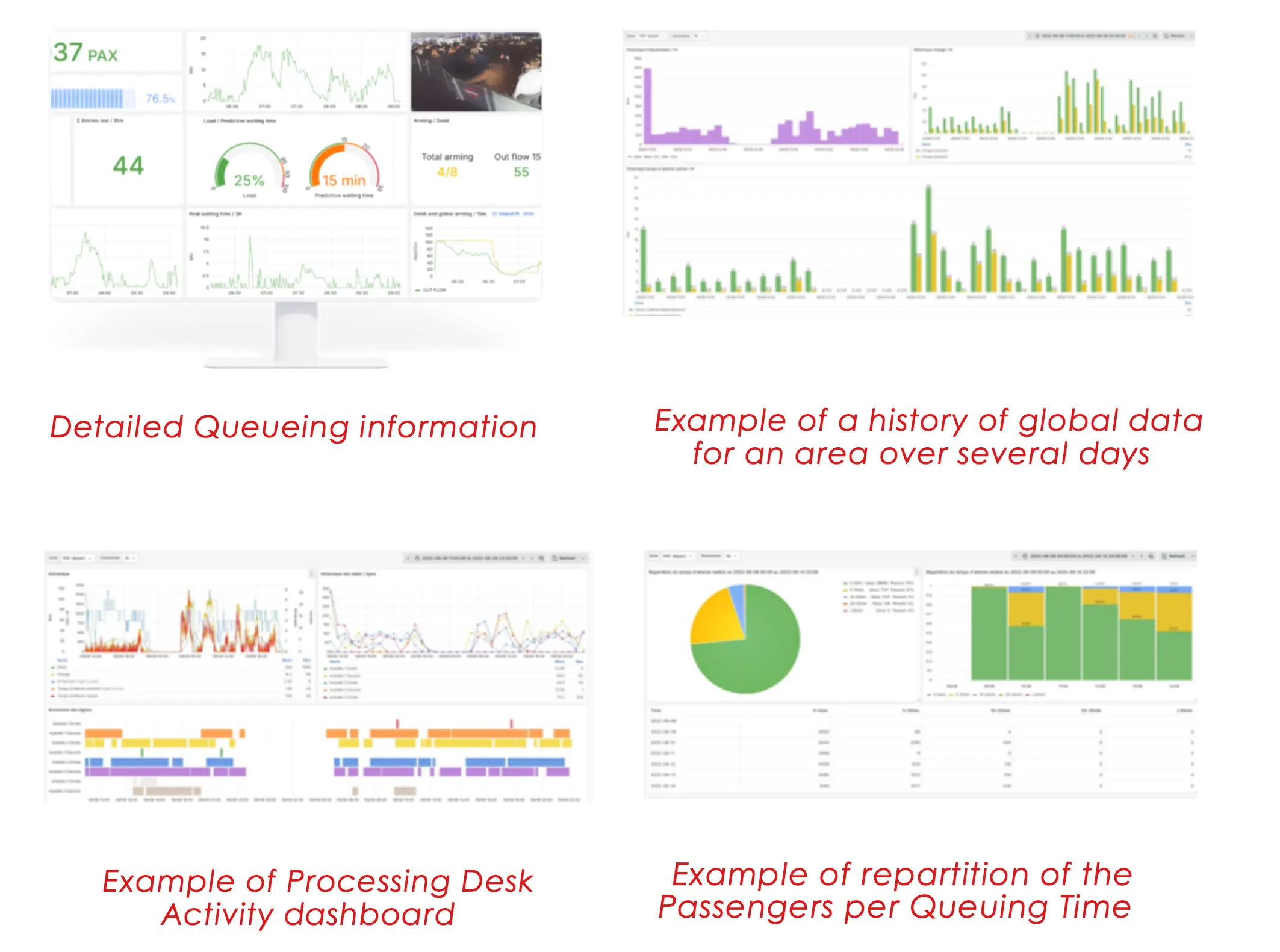
The VISION Clean platform provides managers with occupancy dashboards, historical usage analytics, and passenger flow data.
The VISION Clean platform serves as the centralized intelligence hub, offering comprehensive dashboards.
Managers can view live occupancy levels, access historical usage analytics to identify long-term patterns, and generate detailed cleaning activity reports.
The platform also analyzes queueing and passenger flow, allowing for continuous operational improvement and data-backed terminal planning.
Outcomes
Benefits
Real-time cleaning operations aligned with passenger flow
Reduced overcrowding and improved hygiene standards
Optimised staff allocation and reduced unnecessary interventions
Better passenger comfort and overall airport experience
Full traceability of cleaning operations and SLA verification
Continuous operational improvement through usage analytics
Impact on operational efficiency
The airport now aligns cleaning schedules with actual passenger flow, allowing maintenance teams to prioritise interventions more efficiently.
The airport now aligns cleaning schedules with actual passenger flow, allowing maintenance teams to prioritise interventions more efficiently

The system helps :
Reduce overcrowding during peak periods
Improve hygiene standards
Optimise staff allocation
Reduce unnecessary cleaning interventions
Improve operational responsiveness
Passenger satisfaction has also improved thanks to cleaner facilities and