About client
French international airport
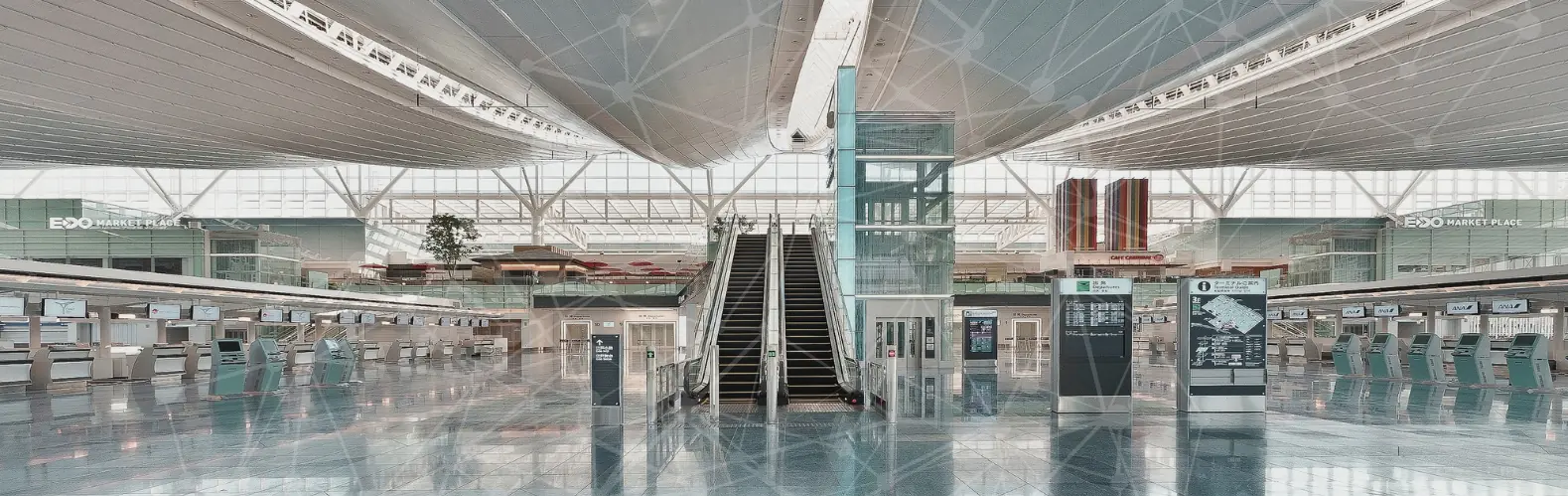
This large-scale airport serves millions of passengers each year, acting as a key transportation hub in Europe. With high traffic variability and strict service-level requirements, operational efficiency and passenger satisfaction are critical. Acorel was selected through a European tender to deploy an advanced queue management and passenger counting system across the airport.
Key operational areas include:
Border control zones
Security screening checkpoints
Check-in counters
Customs and administrative areas
Public facilities (e.g., restrooms)
Complex, high-pressure environment
Managing such a diverse and high-volume infrastructure requires precise coordination between multiple service providers, including security, border police, and airport operations teams. Without accurate data, ensuring smooth passenger flow and meeting regulatory waiting time targets becomes extremely challenging.
Challenge
As passenger numbers increased, the airport faced growing operational pressure.
Key challenges
Peak-hour congestion: Sudden surges in passenger flow
Unpredictable processing times: Especially at security and border control
Queue visibility gaps: Lack of real-time data
Reactive operations: Decisions based on assumptions rather than data
Service quality pressure: Need to meet strict European waiting time standards
Solution
Real-time passenger counting
A network of high-precision sensors using:
LIDAR technology
3D stereoscopic video
Computer vision
Operational visibility & control
All collected data is centralized and made accessible through intuitive dashboards, as well as directly on mobile devices. This allows operational teams and unit managers to monitor situations as they evolve and respond immediately when disruptions or inefficiencies appear. Automated alerts and incident reports further enhance responsiveness, ensuring that potential issues are identified and addressed without delay.
Predictive queue management
Beyond real-time monitoring, the system introduces a predictive layer to airport operations. By analyzing trends and flow patterns, it enables teams to anticipate congestion before it becomes visible.
The platform enables:
Forecasting congestion before it occurs
Triggering timely opening of additional lanes
Anticipating peak demand periods
This allows for timely decisions, such as opening additional lanes or reallocating staff, based on actual demand rather than assumptions. As a result, peak traffic can be absorbed more smoothly, and pressure points can be managed proactively instead of reactively.
Outcomes
Benefits
Acorel transformed airport operations from reactive to predictive, enabling data-driven decision-making at every level.
Real-time operational visibility
Reduced passenger waiting times
Improved passenger experience and safety
Optimized staff allocation
Better infrastructure utilization
Enhanced service provider accountability
From reactive to predictive operations
The airport shifted from managing queues “by feel” to using real-time indicators. Teams can now monitor demand as it builds and respond proactively preventing congestion instead of reacting to it.
Improved resource allocation
Staffing levels are dynamically adjusted based on actual passenger flow:
Avoid under-staffing during peaks
Reduce unnecessary staffing during low traffic
Optimize lane openings
Enhanced passenger experience
By reducing the time spent at mandatory checkpoints, the solution helps create a more seamless and predictable journey through the airport. Passengers experience less stress and uncertainty, while movement across key areas becomes smoother and more efficient, allowing service levels to remain stable even during peak periods.
| Area | Before Acorel | After Acorel |
|---|---|---|
| Queue Management | Manual / reactive | Real-time & predictive |
| Waiting Time Control | Inconsistent | Stable & optimized |
| Staff Allocation | Fixed / assumption-based | Dynamic & demand-driven |
| Congestion Handling | Late response | Early detection & prevention |
| Data Availability | Limited | Real-time + historical analytics |
| Passenger Experience | Variable | Smooth & predictable |