About client
Telecoms operator in France
A leading telecoms operator in France, and in many countries around the world, has been working with Acorel for many years, in relation to the rate of visits to its stores and particularly the transformation rate between customer numbers and turnover.
The numbers speak for themselves:
300+ million customers worldwide
172,000 employees globally
Annual turnover of approximately €40 billion
Present in 75% of European countries and 85% of countries in Africa and the Middle East
105,000 employees and 450 stores in France alone
Overview
This operator has used Acorel sensors for over 15 years in order to measure the number of visitors to its stores and carry out a quantitative as well as qualitative analysis of the location of its points of sale.
With some 450 stores in France, a detailed analysis of visitor numbers and turnover is essential for the business to function properly.
The problem: managing 450 stores without guesswork
Running a 450-store retail network is a logistics and performance challenge of enormous complexity. Without reliable, granular visitor data, he faced several interconnected problems:
No objective basis for store performance comparison. How do you fairly compare the performance of a flagship store in central Paris with a smaller outlet in a regional town? Raw sales figures tell an incomplete story. Without knowing how many visitors entered each store, it is impossible to calculate the true conversion rate the ratio of visitors who become paying customers. A store with modest revenues but a high conversion rate may actually be performing exceptionally well; one with high footfall but low conversions may signal a serious service or product issue.
Staffing decisions were reactive, not predictive. Without data on when visitors arrive by hour, day, and season staffing levels at stores were set on intuition and historical habit rather than evidence. The result: overstaffing during quiet periods (unnecessary cost) and understaffing during peaks (poor customer experience and missed sales).
Network positioning relied on incomplete analysis. When considering whether to open, close, resize, or relocate a store, the operator needed to understand each location's catchment area and visitor patterns. Without this data, the group risked making expensive strategic decisions opening stores where footfall could never justify the investment, or closing stores that were in fact driving meaningful customer engagement.
Supply logistics lacked a demand signal. Without a clear picture of visitor volumes and their relationship to sales, stock replenishment and supply chain decisions were disconnected from actual customer demand at the store level.
The solution: Acorel people counting and analytics
Infrastructure: 800+ sensors across 450 stores
All of the operator’s stores are equipped with more than 800 Acorel sensors. These devices count visitor entries and exits with high accuracy distinguishing genuine shoppers from passersby, filtering out staff movements, and producing clean data that feeds directly into reporting infrastructure. The sensors operate continuously, feeding data into a central database in real time, ensuring that store managers, analysts, and regional directors all have access to the same live picture of what is happening across the network.
Analytics: the FOCUS platform
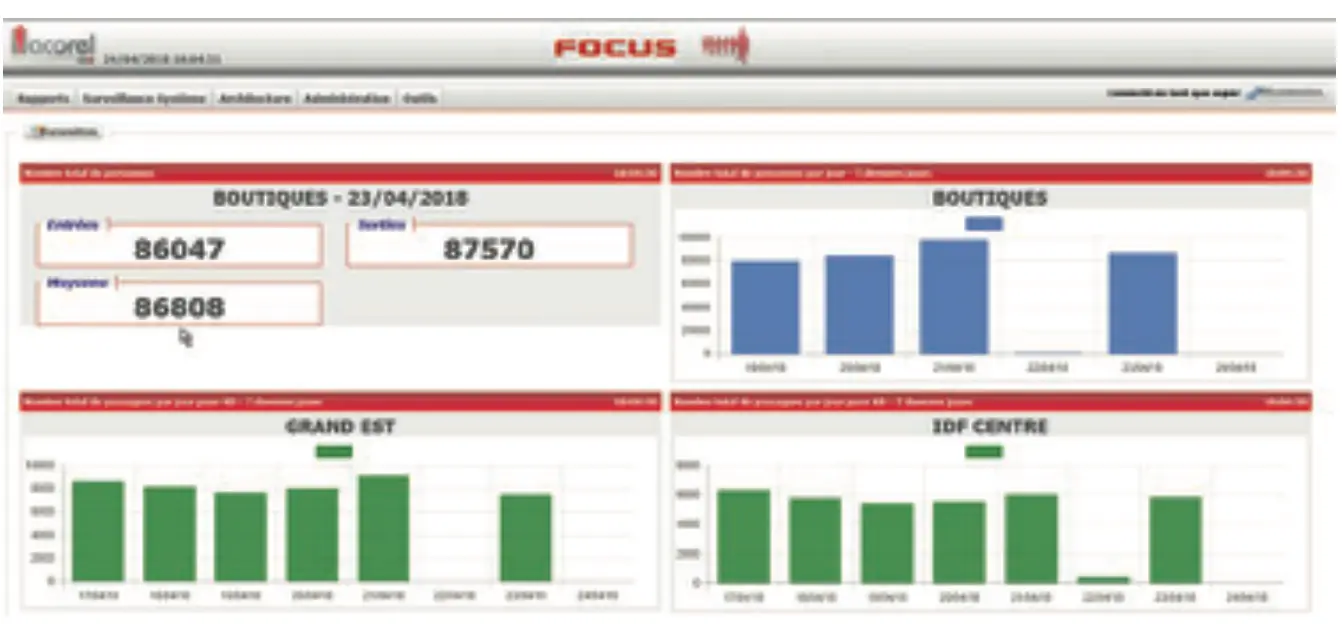
The data collected by Acorel sensors flows into the FOCUS analytics platform, which provides:
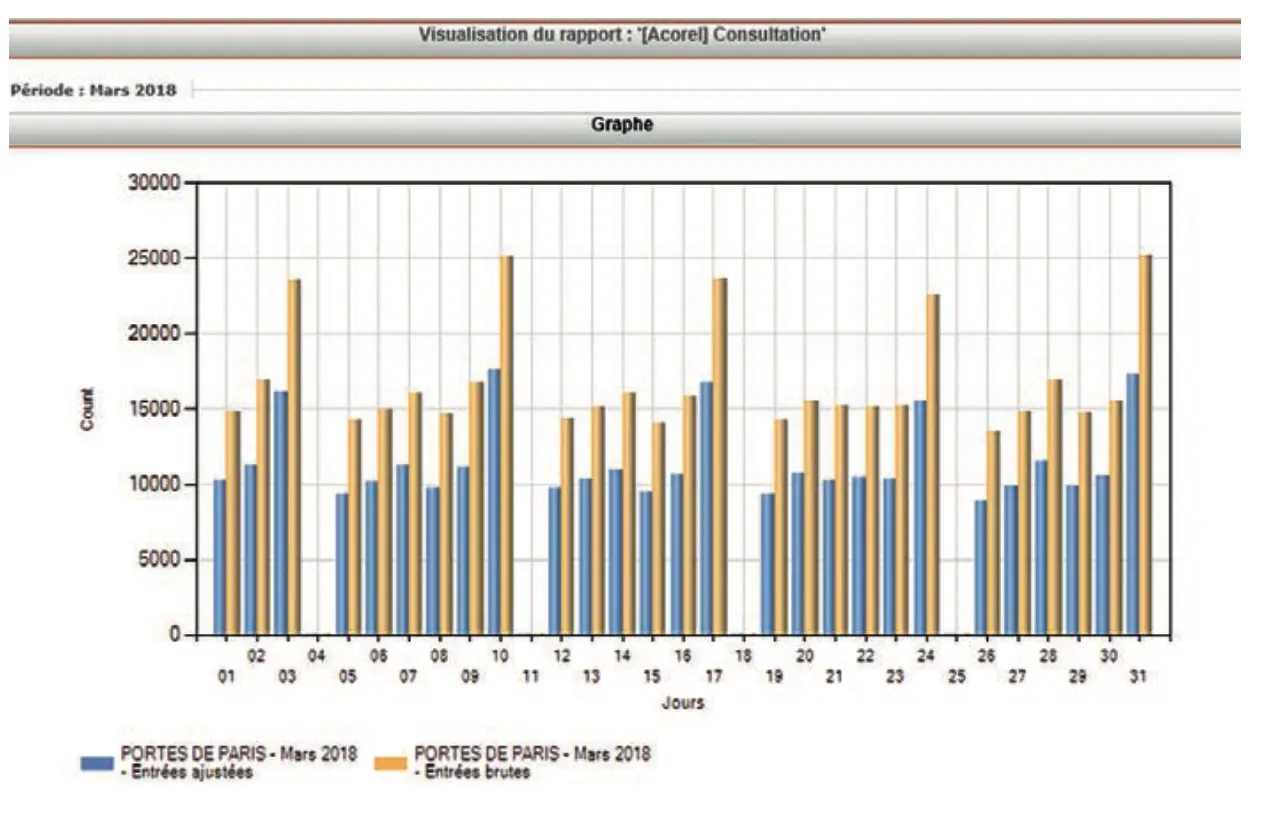
The FOCUS platform’s reporting features allow users to view, for example, footfall data for a store over an entire month, broken down by day and showing both raw and adjusted figures, enabling them to make informed decisions regarding staffing levels, promotions and shop layout.
How it works in practice
Measuring the transformation rate
The central metric uses is the transformation rate: the proportion of store visitors who generate turnover. By overlaying visitor data from Acorel sensors against point-of-sale transaction data, He can calculate this rate for every store, every day. This unlocks a level of insight that raw sales figures simply cannot provide. A store might have lower absolute revenue than its peers but a significantly higher transformation rate meaning it is converting a higher share of visitors into customers, and may simply be located in a lower-footfall area. The strategic response (marketing investment to drive footfall, perhaps) is very different from a store with high footfall but low conversion (which may need service improvements or product range adjustments).
Staffing optimisation
With hourly and daily visitor patterns clearly visible, store managers can schedule staff to match demand precisely ensuring adequate coverage during peak periods and leaner staffing during quieter times. The result is a better customer experience and a more efficient cost base.
By analysing the flows we can position the network of stores and refine the catchment areas in the event of change in each store's turnover. Staffing adjustments may also be made on the basis of the customer/turnover flow ratio, in order to best serve the people who visit the stores
Network positioning and catchment area analysis
When telecoms operator considers opening a new store, relocating an existing one, or adjusting the size of a current outlet, the FOCUS platform provides the analytical foundation for that decision. By mapping visitor flows against geographic catchment areas and correlating them with turnover data, the group can model the likely impact of any network change before committing capital.<br /> This is particularly important because, as the case study notes, not every store can or should be evaluated purely on profitability. Some stores serve strategic or service-continuity purposes and must remain open regardless of their individual financial performance. Acorel's data helps operator make these determinations objectively, with full visibility of each store's role within the wider network.
Supply chain alignment
The correlation between visitor flows and sales also improves supply logistics. When visitor data signals a sustained increase in footfall at a particular store perhaps driven by a new residential development nearby or a local marketing campaign operator can adjust stock replenishment proactively rather than reactively. The result is fewer stockouts, less overstocking, and a supply chain that responds to real customer behaviour.
The results
Key takeaways for retail and telecoms decision-makers
The telecoms operator-Acorel partnership offers several lessons for any retailer considering investment in people-counting and visitor analytics:
Footfall data is only valuable when correlated with other metrics. The transformation rate visitors vs. turnover is far more actionable than raw visitor counts alone.
Network-level insights require network-level infrastructure. A sensor in one store tells you about one store. 800 sensors across 450 stores tell you about your business.
Real-time data changes decision-making speed. When store managers see live visitor counts, staffing decisions become immediate rather than retrospective.
Longitudinal data compounds in value. A 15 year dataset allows trend analysis and forecasting that would be impossible with shorter data histories.
Partner reliability matters as much as product performance. The operator-satisfaction extends to maintenance, logistics, and user training not just the sensors themselves.
Complete operational satisfaction
After more than 15 years of partnership, the outcomes for telecoms operator are clear and measurable across several dimensions.
We are completely satisfied with the logistics management, the supply of processing software, and the systems maintenance.
This is a striking statement from a procurement professional reflecting not just satisfaction with the technology itself, but with Acorel's ongoing service, maintenance, and support across a highly distributed infrastructure of 800+ sensors in 450 locations.
Real-time network intelligence
The telecoms operator french now has live visibility of customer flows across its entire store network. Store managers, regional directors, and central analytics teams all operate from the same real-time data eliminating information gaps and enabling faster, more coordinated decision-making.
Consistent qualitative service improvement
By correlating visitor flows with turnover data across all 450 stores, he has been able to draw meaningful comparisons and act on them. Stores performing below their potential are identified early; root causes (staffing shortfalls, product gaps, catchment area shifts) can be diagnosed and addressed. The result is a qualitative improvement in the service experience offered to operator customers across France.
Long-term data continuity
Because the Acorel system has been in place for over 15 years, telecoms operator now benefits from an exceptional longitudinal dataset. Year-on-year trend analysis at individual store level tracking the evolution of visitor numbers, conversion rates, and catchment dynamics is a strategic asset that no competitor starting from scratch could replicate quickly.
| Technical performance | The sensors deliver accurate, reliable data continuously. Any system that generates frequent errors or requires constant manual intervention quickly loses the confidence of the teams that depend on it. Telecoms operator satisfaction with the quality of Acorel's data is evident. |
|---|---|
| Best-in-class value | The operator procurement team explicitly identified Acorel's quality/price ratio as the best on the market a judgement that has been confirmed over a decade and a half of operational use. |
| Training and user adoption | The most sophisticated analytics platform is worthless if the people who need to use it cannot do so effectively. Acorel's investment in user training was identified by telecoms operator as a key differentiating factor from the outset. |
| Service and maintenance at scale | Managing 800+ sensors across 450 geographically dispersed locations requires robust logistics and maintenance infrastructure. The operator french satisfaction with Acorel's logistics management suggests this has been delivered consistently. |
| Scalability with the business | As operator network has evolved with store openings, closures, relocations, and reconfigurations Acorel's system has scaled and adapted alongside it. That kind of operational flexibility is essential for any technology partner serving a large, dynamic retail network. |